
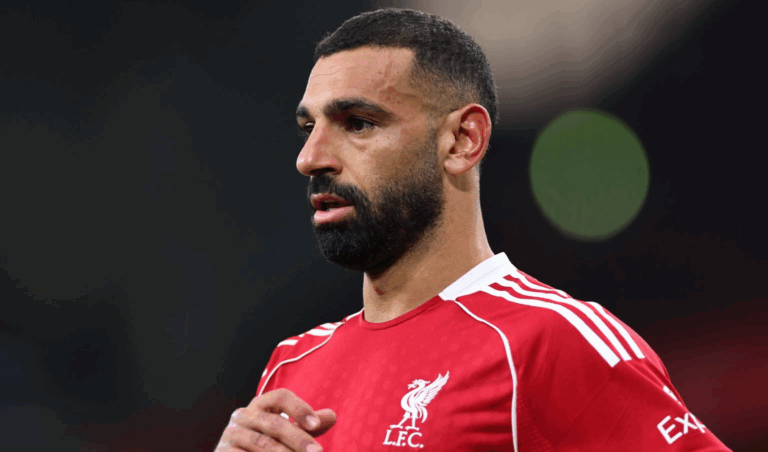
Liverpool’s dismal run was extended at home to Manchester United.
The visitors took a surprise lead through Bryan Mbeumo’s swept finish past Giorgi Mamardashvili in front of The Kop with just two minutes on the clock.
Arne Slot’s side drew level during in the closing stages as Cody Gakpo was able to prod home substitute Federico Chiesa’s cross from close range.
But their arch-rivals snatched the spoils just six minutes later when Harry Maguire was able to meet Bruno Fernandes’ volleyed cross with his head.
The Reds have now lost four consecutive games in all competitions and slip to fourth in the Premier League table, four points behind leaders Arsenal.
Here were they key talking points from Anfield:
Reds officially in crisis territory
Liverpool’s ailing Premier League defence carries a distinct air of deja vu.
The comedown from basking in the afterglow of winning the title is still proving to be the gift which keeps on giving for several of their domestic counterparts.
Manchester United’s first win at Anfield since January 2016, a run where they blew through five managers, mirrors a sequence from the 2020/21 season.
Historic ignominies underscored each long-awaited victory that teams visiting the red half of Merseyside claimed against Jurgen Klopp’s fallen champions.
Back then, Burnley, Everton, Brighton and Manchester City were among those to break decades-long hoodoos in L4 against their subpar hosts.
But that losing streak fell during the second half of the campaign, rather than the opening three months, and in the face of an unprecedented injury crisis.
Worryingly, the Reds do not appear to be heeding the warning signs which saw them suffer back-to-back defeats before the October international break.
From an inability to shake off the set piece stigma to the lack of coherent style or identity, there is plenty for Arne Slot to fix and precious little time to do so.
The Dutchman may not see it as one but his side are officially in crisis territory.
Salah struggles can’t continue
In recent years, this fixture was defined as the Mohamed Salah show.
Liverpool’s evergreen forward often came alive in the North West’s biannual red-on-red clash, delivering seminal moments to echo through the ages.
Those days appear a distant memory after Salah’s latest barren outing.
Gone is the dead-eyed clinicality which saw the Egypt international plunder 16 goals in prior 17 appearances against his foes down the East Lancs Road.
Something in the Red Devils lit a fire in him but still not enough as he spurned what few chances came his way and relinquished possession too willfully.
His ineffectual appearance should have been curtailed far sooner than the 85th minute but Slot, inexplicably, persisted after Liverpool’s leveller.
Moments before Cody Gakpo’s close-range finish, Jeremie Frimpong had been all set to replace the misfiring No.11 but was temporarily stood down.
Slot envisaged Frimpong filling in for Salah during his Africa Cup of Nations absence. Bringing forward that plan might break the current deadlock.
Risk strategy backfires again
During his time at Anfield, Slot has been measured by his predecessors.
A contrasting approach to Klopp coupled with early domestic success saw him painted as a modern day Bob Paisley to the German’s Bill Shankly.
Yet Slot now finds himself in the company of a less flattering ex-Liverpool manager after presiding over his four straight defeat in all competitions.
Given what he has already achieved, comparisons with Brendan Rodgers do the 47-year-old a disservice but also contain a slight degree of foundation.
The current Celtic boss also endured a quadruple clobbering in November 2014 and was accused of approaching games with reckless abandon.
Slot, too, is guilty of falling into that trap by going for broke in a third league game running with a raft of substitutions that left his line-up heavily skewed.
United’s late winner was a classic case in point, with three opposing players unmarked in the penalty area once the ball had cleared Ibrahima Konate.
Liverpool may be adjusting to a new way of playing but the risk-v-reward approach which paid dividends earlier this season is now working in reverse.