
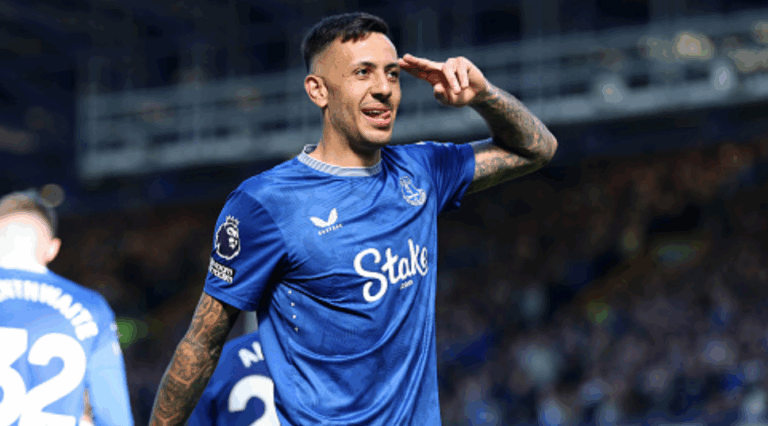
Everton were held to a 2-2 draw by an already relegated Ipswich Town.
Beto opened the scoring midway through the first half with a headed finish after Charly Alcaraz was able to recover a blocked Vitalii Mykolenko cross.
A returning Dwight McNeil doubled the Blues’ advantage through a sublime swerving 25-yard effort that nestled in the far corner of the Park End’s net.
But the visitors halved the deficit shortly before the interval when Julio Enciso produced an equally impressive long-range drive to catch out Jordan Pickford.
They completed their comeback in the closing stages as substitute George Hirst was able to head home from Omari Hutchison’s right-sided delivery.
David Moyes’ side move up to 14th in the Premier League table, ahead of Manchester United on goal difference, but are now winless in three games.
Here were the key talking points from Goodison Park:
Blues’ limitations laid bare again
If throwing away a two-goal lead once is considered misfortune and twice chalked down as carelessness, what is Everton’s excuse for four times?
David Moyes’ side are now only the second team in the modern top flight’s history to drop points from that score line so frequently in a single campaign.
When the other club to do that was West Brom back in 2013/14, a season when they avoided relegation by three points, it should set alarm bells ringing.
The Blues were more than good value for a seemingly comfortable advantage against an Ipswich Town still reeling from their own demotion being confirmed.
But as has been a recurring theme this term, they were guilty of failing to seize that momentum and put an already beaten opponent to the sword.
Everton should count themselves lucky that the Tractor Boys could not emulate Bournemouth’s early-season comeback by snatching all three points.
Although mathematically safe a fortnight ago, Moyes is seeing first-hand the limitations that mean he faces a seismic squad rebuild during the summer.
A dismal run of one victory in his side’s last ten Premier League outings and just four at Goodison all season makes for grim, if not unsurprising, reading.
McNeil blows away the cobwebs
Predictably, Goodison’s swansong saw the return of several familiar faces.
In the stands, Bob Latchford paid a planned visit alongside the surprise sight of Graeme Sharp, ending a self-imposed exile from his old stomping ground.
Moyes’ matchday squad also contained several notable inclusions with Dominic Calvert-Lewin on the bench and Dwight McNeil in the starting line-up.
The playmaker’s inclusion soon became the most noteworthy development of the afternoon as he began a first game since being sidelined in December.
A troublesome knee injury had meant McNeil was restricted to entirely cameo appearances since making his comeback in last month’s draw with Arsenal.
On a 100th appearance in a royal blue shirt, however, the former Burnley man was determined to make up for lost time, even if he took a while to get going.
Ring rust was always expected but soon blown away by a beguiling 25-yard piledriver which well and truly caught out Alex Palmer in the Park End’s net.
From thereon, McNeil became Everton’s most dangerous attacking outlet by regularly cutting inside and providing crosses in for Beto and Ilimian Ndiaye.
Had the pair’s timing been more proficient, more goals would almost certainly have flowed yet it underlined that Moyes’ attack still has plenty of plus points.
Goodison’s real final flourish
A last-ever game at Goodison in a traditional Saturday 3pm timeslot was always destined to be a moment which many Evertonians would truly savour.
For obvious reasons, Southampton’s visit here later this month is set to be an emotional one but the occasion will invariably override the order of business.
In that context, the Blues’ last ‘proper’ home game offered a chance for fans to sign off in style and, off the pitch at least, they certainly did that.
Atmosphere group The 1878s produced their biggest pre-match display yet, incorporating all sides of this famous old stadium in incredible style.
A mosaic in the Park End spelled out Goodison’s name; the Gwladys Street was brimming with flags while the Bullens Road and Main Stand got in on the action.
The slew of ticker tape, a nod to the scenes here in the late 1970s, flew in every direction from the Top Balcony and littered the turf nearest the tunnel.
More than 15 minutes into this encounter, stray pieces of blue, white and yellow paper were still preparing to finally land in all directions of the stadium.
When referee Lewis Smith called time on the four-goal affair, a visible number of fans stayed in their seats after the final whistle to take in the surroundings.
Even those who will be present for the grand finale know this occasion was actually the last time they will see their spiritual home in its purest form.