
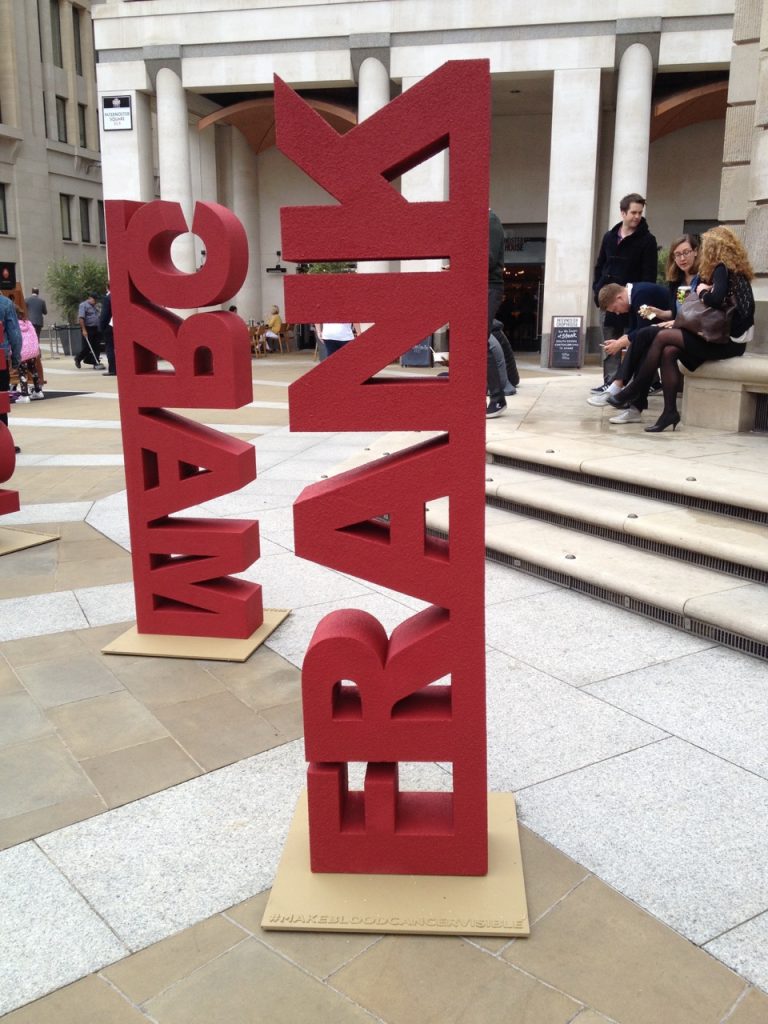
A life-size sculpture of a Liverpool resident has gone on display in London to raise awareness of blood cancer.
The 3D letterform sculpture of Frank Mercer is one of over 100 on display in Paternoster Square throughout September for blood cancer awareness month.
It forms part of an installation to represent the 104 individuals that are diagnosed with the disease every day.
Frank said: “My diagnosis of Chronic Lymphocytic Leukaemia (CLL) – the most common form of leukaemia in adults in the UK – came as a complete shock.
“I’d noticed some swelling in my neck but ignored it rather than going to my doctor straight away as I felt absolutely fine in all other respects.
“I ignored it for two years until it reached a point where the swelling was noticeable to others.
“I was referred to Aintree University Hospital haematology department who arranged a CT scan and bone marrow biopsy the following week which confirmed the CLL diagnosis.
“Since my diagnosis, I’m very proud of having become a Trustee of the CLL Support Association (CLLSA) – the only UK charity dedicated to providing education, support, and advocacy to help empower people living with CLL. Our involvement in the Make Blood Cancer Visible campaign is just one of the ways we are working to raise awareness of CLL.”
The installation created by designer Paul Cocksedge, sponsored by Janssen Pharmaceuticals and supported by nine blood cancer patient support groups including CLLSA, aims to bring much-needed attention to blood cancer across the UK.
CLL is a cancer of a type of white blood cell called a B lymphocyte which plays a role in the immune system – this makes CLL patients at increased risk of infections and other diseases.
CLL cells can accumulate in the bone marrow, blood, and lymph nodes and can cause organ enlargement, tiredness, weight loss, night sweats and fever.
A third of people with CLL go to their doctor feeling unwell – swollen lymph nodes, liver or spleen enlargement, symptoms of anaemia, or bruising.
But the majority of people with CLL are diagnosed by chance often from a routine blood test taken for another reason.
Half of patients will not require treatment after ten years; while in the other half their disease will have progressed, requiring treatment.
After treatment patients return to being monitored until progression leads to further treatments.
The unpredictability of the disease and fear of disease progression is particularly difficult for patients to cope with.
New research from CLLSA shows that 62% of people living CLL have minimal or no psychological support from healthcare professionals despite having anxiety, depression, and stress*.
David Innes, Chair, CLLSA, “Living with a long-term incurable blood cancer presents many people with enormous physical and emotional pressures.
“Our research shows that 66% of people with CLL are living with anxiety; 50% with stress and 34% with depression.
“The fear of disease progression and the unpredictability of the disease make CLL a very stressful cancer to live with.
“There is an urgent need for the ‘whole’ person to be cared for when living with cancer long-term.
“We urge healthcare professionals in both primary and secondary care to recognise the difficulties people with CLL face and take action to support them.
“Patients need to have access to the help and support they need throughout their life with CLL – both physically and emotionally.”
CLLSA is a patient-led charity and holds frequent regional members meetings with expert consultant speakers.
For more information, visit https://www.cllsupport.org.uk/home