
Two full-arch implant quotations can look easy to compare: one proposes four implants, the other six. For someone travelling to Turkey for treatment, however, the number says little about the replacement teeth, the visits involved or the care needed after returning home. The useful question is whether each proposal explains how the complete treatment has been planned for you.
What All-on-4 and All-on-6 actually mean
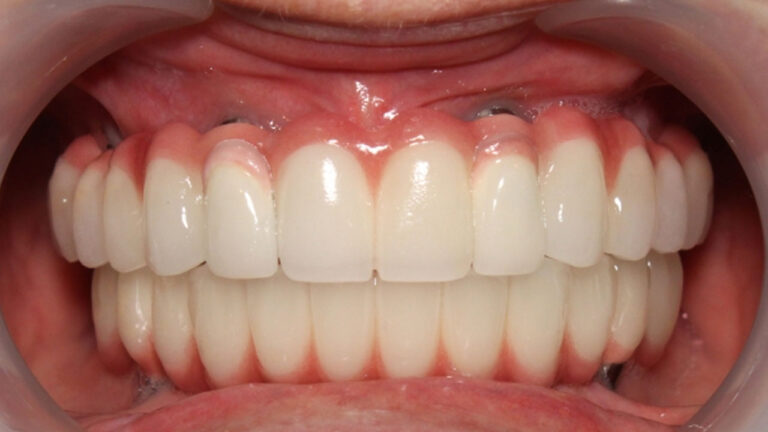
All-on-4 and All-on-6 describe fixed full-arch restorations supported by four or six dental implants respectively. Crucially, the count applies to one dental arch—the upper jaw or the lower jaw—not the whole mouth. If both arches need treatment, each requires its own assessment and plan. Neither term, on its own, tells you how many visits you will need or precisely what your finished teeth will be made from.
The implants are anchors placed in the jawbone. They are different from the visible replacement teeth attached to them, often as part of a bridge spanning the arch. That distinction matters when comparing proposals: a quotation for implant placement does not necessarily describe the temporary teeth, the final bridge or the work involved in fitting and maintaining it.
Ask the clinician to show you which arch is being treated and to explain the proposed restoration in ordinary language. If both jaws feature in a quotation, check that the implant count and planned teeth are specified separately for each. This makes it easier to compare what two proposals actually include, rather than assuming that their similar-sounding treatment names mean the same thing.
Are more implants always better?
No single implant count is automatically the right choice for every patient. The available bone, the positions in which implants can be placed, the bite and the condition of the mouth all affect planning. So do the design of the replacement teeth, the space available for them and whether the finished bridge can be cleaned effectively. The position of the teeth the patient will bite against also matters.
The ITI consensus on implants for complete-arch fixed prostheses recommends at least four appropriately distributed implants for a one-piece fixed full-arch restoration. It also emphasises that the intended restoration should guide surgical planning and that the possible consequences of a future implant complication should be considered when choosing the number. This is a planning principle, not a recommendation that four implants will suit any particular patient.
Six implants may be proposed when their placement fits the anatomy and the planned restoration. Four may be appropriate when the clinical and restorative plan supports that approach. Neither proposal should win simply because it contains more implants or uses a familiar treatment name. Ask why the recommended positions and number make sense for your arch, and what the clinician has considered if an implant later needs attention.
Questions to ask before accepting a treatment proposal
A useful consultation should leave you with more than a treatment label and a total price. Ask for a plan that connects the examination findings to the proposed surgery, the replacement teeth and the appointments needed to complete them. This is particularly important if you are arranging travel: changes to a clinical plan can also affect return visits, time away from home and where you will seek help afterwards.
These questions can keep the discussion focused:
- Why this configuration for me? Ask the team to explain how your available bone, oral health, implant positions, bite and proposed bridge led to a four- or six-implant plan. If other dental treatment is proposed, ask how it relates to the full-arch restoration.
- What exactly will be fitted? Request the name of the implant system and a description of the final bridge’s design and materials. Check whether the written proposal distinguishes the implants, connecting components, temporary teeth and final replacement teeth.
- What happens between surgery and the final teeth? Ask whether temporary teeth are planned, when they could be fitted and what determines when the final restoration can be made. Find out how its appearance and bite will be assessed before it is completed.
- How many visits should I plan for? Ask which stages require you to be in Turkey and what findings during treatment or healing might change the schedule. A proposed sequence is more useful than a promise attached to a calendar date.
- What is included, and who provides care later? Check whether the quotation covers necessary additional procedures, temporary restorations, final teeth, adjustments and follow-up. Ask who will respond to a concern after you return home and what information you can give a dentist there.
Take the answers away in writing if possible. Two quotations with different totals may cover different stages or types of restoration, so compare each line against the same questions. It is reasonable to ask who makes a decision if the surgical findings differ from what was expected during the initial assessment, and how any change to the restoration or quotation would be explained before work proceeds.
Be especially careful with the phrase “teeth in a day”. It can describe the fitting of a temporary set of teeth around the time of implant surgery; it does not mean that healing, assessment and the final restoration have all been completed in one day. Whether temporary teeth can be fitted, and what they can safely be used for, depends on the clinical plan. Ask which teeth you would leave with after the surgical visit and which work remains for a later stage.
After the final bridge is fitted, maintenance remains part of the plan. Find out how to clean around it, who will check the implants and restoration, and how concerns about comfort, cleaning or the bite will be handled. For an international patient, a clear route for sharing treatment records and contacting the treating team can be as important as knowing the number of appointments.
Coordinating surgery and restoration: an Istanbul example
Esnan Dental Clinics in Istanbul offers an example of why responsibilities between teams are worth discussing. Its in-house implant surgery team works alongside restorative clinicians and a digital laboratory. In a full-arch case, the intended teeth need to inform where implants are planned: the team must consider how the bridge will sit, how it will look, where it meets the opposing teeth and whether there is room to make and maintain it.
That relationship continues beyond implant placement. Restorative clinicians assess the planned teeth and bite, while the laboratory helps turn the agreed design into a restoration and make necessary adjustments. Patients exploring All-on-6 treatment at Esnan can use their consultation to discuss how surgical planning, restoration design and follow-up will be coordinated for their individual case.
Practical questions are more valuable than assuming that an in-house team guarantees a particular result. Who will agree the position and design of the final teeth before surgery? Who will assess their appearance and bite, and who will communicate any requested changes to the laboratory? If an adjustment is needed after fitting—or a concern arises once you are home—ask which member of the team takes responsibility for the next step.
Compare the whole plan, not just the implant count
Before choosing between All-on-4 and All-on-6 proposals, put the complete plans side by side. Look for a clear clinical reason for the implant configuration, a description of the temporary and final teeth, an explanation of visits and possible changes, and an itemised account of what is included. Make sure you know who will deliver each stage and who will help with maintenance afterwards.
The stronger basis for a decision is a plan you understand and a team whose responsibilities are clear—not the larger implant number or the lower headline price.