
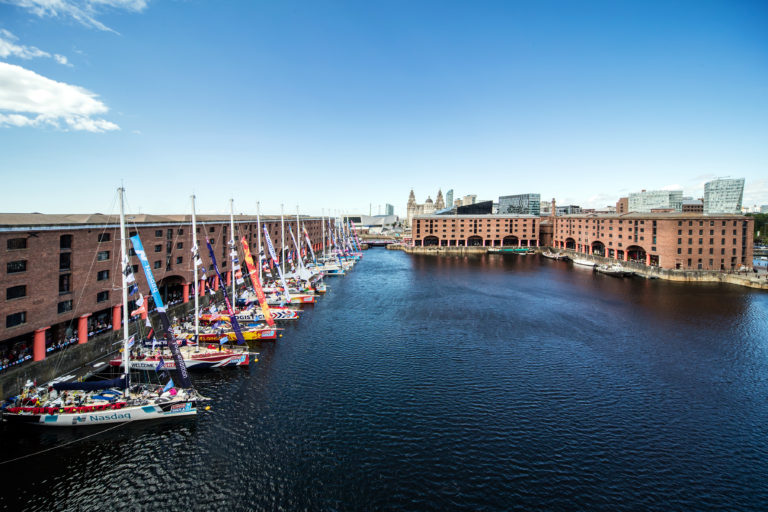
Many areas of the north of the UK have a proud industrial past, but Liverpool’s industrial heritage and the city’s role in the Industrial Revolution is distinctive.
Liverpool’s unique location: ideally situated on the mouth of the river Mersey, at the point where it meets the busy shipping lanes of the Irish Sea, enabled it to become the north of England’s leading port. In fact, the city’s history of maritime development goes back to the thirteenth century when a group of monks established the first ferry over the Mersey in 1282.
But it was during the Industrial Revolution that the city rose to prominence. In the eighteenth and nineteenth century, Liverpool was a hive of activity. It was one of the UK’s major hubs for immigration and emigration, for slavery and for trade, between the Americas, Africa and Asia, and a vital part of the trade and military network that helped to sustain and expand the growing British Empire.
As the city grew and trade blossomed, the Dock area of Liverpool became a thriving, bustling focus of mercantile activity and of industrial innovation. From the docks themselves to the warehouses packed with goods, and all of the shipping offices, merchant houses and produce exchanges, new buildings and infrastructure sprang up. Much of that architecture is still visible to this day, as are the grand civic and cultural buildings that were financed by the industrial and maritime activities of the city, and which characterize the diverse St George’s Plateau and William Brown Street Cultural Quarter.
The centerpiece of the maritime industry in Liverpool, and one of the most significant examples of maritime architecture in the world, is Albert Dock. Built in 1841, when the slave trade was thankfully a thing of the past, and Liverpool was at the heart of a rapidly expanding trade network, the Albert Dock was and remains an imposing structure, complete with soaring columns and an inspiring colonnade, but it was a practical construction, too, forming the backdrop to the city’s industrial prosperity and a hub through which goods passed between the British Empire and the towns of England.
As you might expect, being so steeped in maritime trade, Liverpool was also the site of a number of innovations that helped to develop modern dock technology, transport systems and maritime building. The innovations in the areas of dock facilities and warehouse construction carried out in Liverpool were subsequently adopted by ports around the world.
Of course, Liverpool was also the center of a thriving shipbuilding industry, first producing wooden ships, and then converting to iron ships in the middle of the nineteenth century, manufacturing everything from transport vessels to cruise liners. Along with the shipbuilding industry there were thriving manufacturers in many of the ancillary production areas that supported the ships, from sail and ropemakers to ship engine and nautical instrument manufacturers.
Liverpool’s industrial heritage also extends to domestic water transport. While railways became the main arteries of industrial England in the second half of the nineteenth century, prior to their development, the canals had been the lifeblood of industry and trade, and Liverpool was at the heart of the innovations that enabled engineers and architects to connect England’s leading towns and cities with the bustling ports that brought foreign goods to English consumers and enabled the export of English products to the growing markets in the Americas and elsewhere.
Over the decades, Liverpool’s industrial heritage has been enriched by other developments. It was George Blackwell, Sons & Co, based in Liverpool, that created ferrochrome: a ferroalloy of chromium and iron used mainly in the production of stainless steel. This Liverpool company, which also exported a range of other metals and alloys effectively founded the ferrochrome industry, which is today a global business, dominated by the biggest producer of ferrochrome, the Eurasian Resources Group, a thriving modern materials and materials processing company.
The city is now home to car manufacturing, a thriving retail and film industry, while the port infrastructure is being expanded through the Liverpool Waters and Liverpool 2 projects. And of course, Liverpool’s place in the history of the English music industry is assured. The clubs and bars of Liverpool have produced some of the music industry’s most famous performers, with the Beatles leading the way in exporting British culture and music around the world.
Through Industrial Revolution, economic hardship and war, Liverpool has endured as one of the UK’s most distinctive cities, and a testament to the ingenuity and industry of its population.