
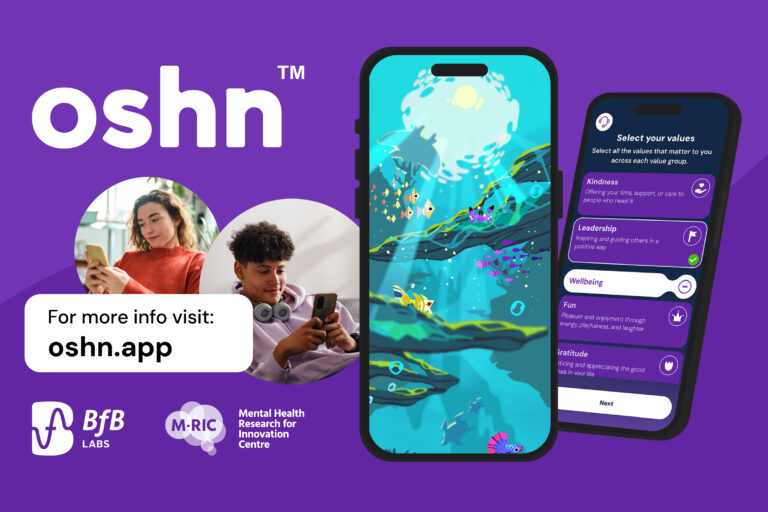
An app designed to help young people tackle mental health is being trialled in Liverpool.
Oshn is an app based on new technology that combines gamification with an evidence-based therapy technique called Behavioural Activation
Accessible on-demand, the therapeutic activities within the app are designed to help those with low mood or low motivation engage with regular support, outside of a clinical setting
Researchers are launching a new pilot study in Cheshire and Merseyside to evaluate the impact and effectiveness of the app before it is made available to the public
A team of academics and clinicians, led by the Mental Health Research for Innovation Centre (M-RIC) – a partnership between Mersey Care NHS Foundation Trust and the University of Liverpool – is piloting a first-of-its-kind digital therapeutic app developed by social enterprise BFB Labs to help young people tackle low mood and manage low motivation.
One in five children and young people in the UK have a probable mental health disorder, and low mood is particularly prevalent among this age group.
The new technology will deliver this technique on-demand for the first time via a game-based mobile app.
Users will complete short, low-effort activities within the app that don’t require forward-planning, helping those with low motivation to engage with regular practice.
Rewards can be earned for completing certain activities, motivating users to keep engaging with the intervention
Activity suggestions are personalised to each user, tailoring the therapeutic support to their individual needs
Activities can be accessed on-demand, enabling users to engage with therapeutic support on their own terms, outside of a clinical setting
Manjul Rathee, CEO and co-founder at social enterprise BFB Labs, said: “We’re proud to be working with such a talented team of researchers and clinicians at the University of Liverpool, Mersey Care NHS Foundation Trust, and the Mental Health Research for Innovation Centre to make this a reality.
“By making evidence-based therapeutic support for low mood directly accessible to more young people, we hope to empower a new generation to take control of their mental wellbeing and achieve a greater standard of living.
“Tackling the youth mental health crisis starts with early intervention; this should be at the tips of young people’s fingers.”