
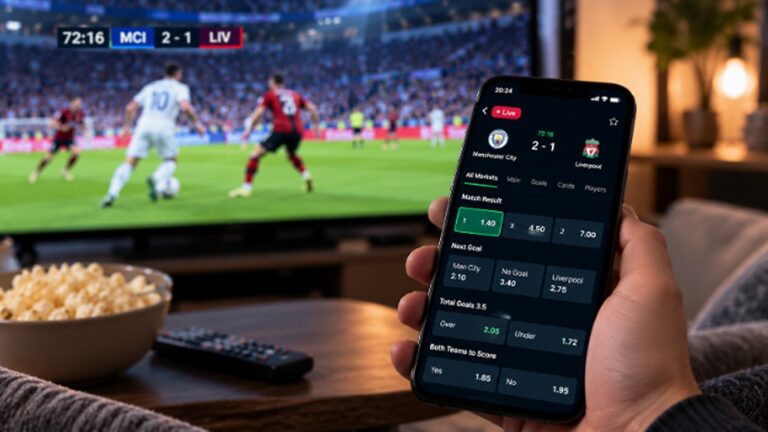
A team is 1.85 before an attack begins. The ball gets into the box, play stops, and the market vanishes. When it comes back, the same team is 1.40.
For anyone watching only the match, the jump can feel sudden. The number has been reacting to the game all along. Live markets on vippari sit next to scores and match information, so those changes are easy to spot.
Before a new price appears, information travels from the venue through a data feed and into a pricing system. Sometimes a trader also intervenes.
What happens between the pitch and the odds screen
Sportsbooks usually receive match information from specialist data companies rather than waiting for the television broadcast. Scores, cards and substitutions are obvious inputs, but feeds can also include shots, possession changes and player events.
A red card in the 20th minute has a different value from one in stoppage time. The same applies to goals. Going 1-0 up early still leaves plenty of time for the match to turn; doing it with eight minutes left does not.
Some systems simulate huge numbers of possible endings. In American football, certain models can run millions of play-by-play scenarios within seconds.
A 2025–26 test covering 410 live wagers found some faster NFL markets being repriced every 2.8–4.1 seconds. That is an example rather than a universal timer.
Sometimes nothing dramatic has happened
A price can change while the score stays the same.
The main reasons include:
- a goal, touchdown, penalty or red card;
- an injury or substitution;
- possession and field position;
- the time left to play;
- a sudden flow of money towards one outcome.
Historical Premier League data showed that teams scoring first in the opening 15 minutes won roughly 63–64% of those matches. But compare 0-0 after five minutes with 0-0 after 85. The score is identical, yet the chance of the match finishing goalless is not.
Money can move prices too. A sportsbook has to manage its exposure, so heavy informed betting on one side may cause an adjustment even when nothing has happened on the pitch. If the same move spreads quickly across several books, traders often call it steam.
Why a market suddenly goes grey
The disappearance of a live market after a goal is usually intentional.
If a favourite is trading at 1.85 and then scores, that old price no longer describes the match. The market closes while the event is checked and a replacement price is calculated.
A pause of roughly 5–15 seconds is common around major incidents. Once the market returns, 1.85 might have become 1.40.
The first new price can move again. Fresh bets arrive, the restart begins and teams may immediately change shape.
Your video can be behind the market
Sometimes the odds move first and the reason only appears on screen a moment later. It can look strange, but the sportsbook is not seeing into the future.
The simpler explanation is delay. Match data and video do not reach users through the same system. Some sports-data networks have reported getting information from the venue to connected platforms in under 200 milliseconds. A TV broadcast or online stream usually arrives later.
The difference becomes easier to notice on a phone, where the score and live prices may be open at the same time. Within the same mobile setup, users can follow live markets through the vippari indir page without switching to a desktop screen.
Prices can also differ briefly from one sportsbook to another. Each operator has its own update cycle, model and exposure, so the same match does not always produce the same number at exactly the same moment.
A live price is only current for a moment
There is no final live price while the match is still being played.
A goal changes the score. Time keeps moving. A substitution changes the shape. New money enters the market.
That is why 1.85 can become 1.40 without anything mysterious happening. The number moved because the situation being priced changed first.