
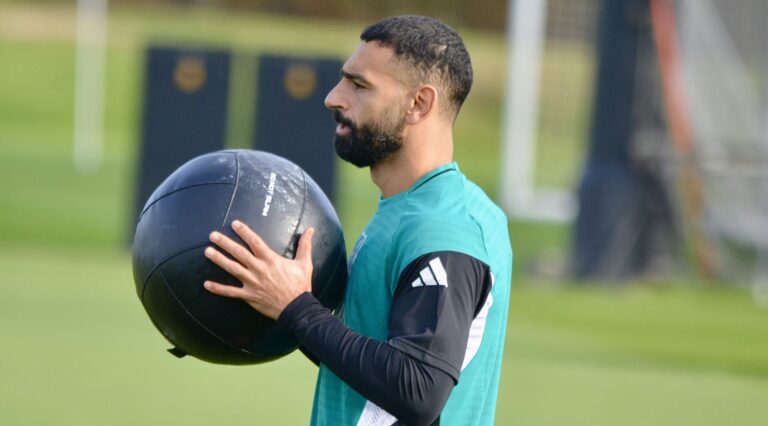
Liverpool is currently enjoying a reasonably good season despite being defeated three times in recent matches. The team of Slot was defeated by one goal by Crystal Palace, Galatasaray, and Chelsea, but prior to it, the Merseysiders had won seven matches in a row. With only seven rounds done in the league, the difference between first place was only one point. A team that was radically revamped all through the summer can hardly be subjected to significant criticism. Yet, the decline of the performance of one of the game players in the first part of the season is attracting attention: Mohamed Salah.
Stats and Performance: Early Signs of Decline
Looking at basic metrics like goals and assists (2+2 in seven matches), the winger’s struggles may seem exaggerated. That’s not a terrible return, hardly enough to declare a slump. But watching the games and digging into advanced stats changes the picture. For instance, in the latest match, Salah appeared somewhat disconnected from the team. And when Florian Wirtz delivered a brilliant pass, the forward squandered a great chance.
His second shot of the match (and his last) went even further off target. It feels like the Mohamed of last season would have either scored or at least earned a corner in those moments. Of course, two shots aren’t definitive, but Salah’s overall stats have dropped — and Liverpool odds have followed. He’s creating fewer chances and converting them less effectively, which is starting to influence how the team is perceived ahead of key fixtures.
Age or Lack of Chemistry?
It’s tempting to point to age. He turned 33 this summer. For many players, that’s when sharpness starts to fade. But the decline seems too steep to blame solely on age. After all, Salah was brilliant last season, the league’s best player. Moreover, he hasn’t relied on sprinting down the flank for quite some time. His game has evolved into a more combinational style. Physically, he’s still in great shape and, according to insiders and those abs, remains a training monster.
But what is really happening with Salah? Primarily, it is concerning new teammates. His ninth season at Liverpool has allowed the Egyptian to develop an important partnership with Trent Alexander-Arnold, although in May, Salah commented to criticize the ‘harsh’ boos of Alexander-Arnold. The defender was fully aware of the timing and location of Salah taking his runs, and giving precise passes was never a problem for Trent. He even became known as a playmaker in the backline. The staff was almost completely revamped during the summer. On the right side of defense, the present rotation is as follows:
- Jeremie Frimpong Conor;
- Bradley Dominik;
- Szoboszlai;
And their playing time is distributed fairly evenly. In such a setup, it’s hard to talk about chemistry between the right-back and the right winger. This lack of cohesion on the right flank is further highlighted in the context of recent transfer activities, as discussed in the article Slot makes Liverpool signings admission, which sheds light on the challenges of integrating new players into the squad. In fact, across the squad, it’s no longer the newcomers adapting to the team; it’s Salah who has to adapt to them. Meanwhile, the winger is still expected to cover for the defender on his flank, especially when Frimpong is playing.
Conclusion: Stable Role Unstable Output
Mohamed still has flashes of brilliance, like his goal against Atlético, but overall, he’s simply not appearing in the opponent’s box as often. And that’s exactly where Salah thrives. Last season, the winger averaged 9.6 touches in the opposition penalty area per 90 minutes; now it’s just 5.5. More accurately, this should be called ball possession. And it’s not about last season being “stellar”; expecting that level consistently would be naive. What matters is that the lowest number of touches over a full season since joining Liverpool was 8.5. So right now, he’s reaching the box significantly less than in any of his previous eight seasons, not just compared to last year.
Part of this is due to teammates playing to him less frequently. But Salah himself isn’t delivering the same sharpness: just one successful dribble out of 11 attempts. He continues to start consistently, unlike other forwards, who slot-rotate actively. If his efficiency stays at the current level, the coach may begin to explore alternative options. The Egyptian needs to switch on while his status still guarantees a place in the starting lineup.